
SQL intelligence
Completion, inspections and formatting are built on Tablecloth's own tokenizer and the live catalogue from introspection. They work in consoles and in .sql files attached to a source.
Completion
- Objects in scope. Schemas, tables, views and columns, quoted when the dialect would fold or reject the bare name (
"Programs"on PostgreSQL, backticks on MySQL). Completing inside a quote you've already typed keeps that quote. - Keywords for the clause you're in. After a complete term you get keywords only, with the likely ones first:
WHEREafter a table,IS NULL,IN,LIKEandBETWEENafter a column name,RETURNINGoutside MySQL. - Aliases. After naming a table you're offered IntelliJ's alias for it:
Programs→P,LiveStream→LS. - Functions, inserted with their parentheses.
JOIN inference
After JOIN, tables with a foreign key to or from the ones already in the query come first, and accepting one writes the whole clause. After ON you get the condition on its own.
SELECT * FROM orders o JOIN cu▌
                            └─ customers c ON c.id = o.customer_id
Live templates
Type the abbreviation at the start of a statement and accept it; tab through the placeholders.
| Abbreviation | Expands to |
|---|---|
sel |
SELECT * FROM table |
selc |
SELECT count(*) FROM table |
selw |
SELECT * FROM table WHERE condition |
ins |
INSERT INTO table (columns) VALUES (values) |
upd |
UPDATE table SET column = value WHERE condition |
del |
DELETE FROM table WHERE condition |
tab |
CREATE TABLE name ( id integer PRIMARY KEY ) |
col |
name type (a column definition) |
ind |
CREATE INDEX name ON table (columns) |
view |
CREATE VIEW name AS SELECT * FROM table |
Inspections
Unresolved tables and qualified columns get a warning squiggle, and so do bare columns in single-table statements. The quick fix (⌘.) offers Change to 'x' for the closest existing name.
A DELETE or UPDATE with no WHERE clause is flagged over the whole statement. This check needs no catalogue, so it works before introspection has finished. It follows IntelliJ's exemptions: a LIMIT, a JOIN whose ON or USING condition constrains the table being written, and an UPDATE whose every assignment reads its own column (SET hits = hits + 1) are left alone. A WHERE inside a subquery doesn't count, and neither does the verb inside a clause such as ON DUPLICATE KEY UPDATE or FOR UPDATE. Running the statement anyway asks first.
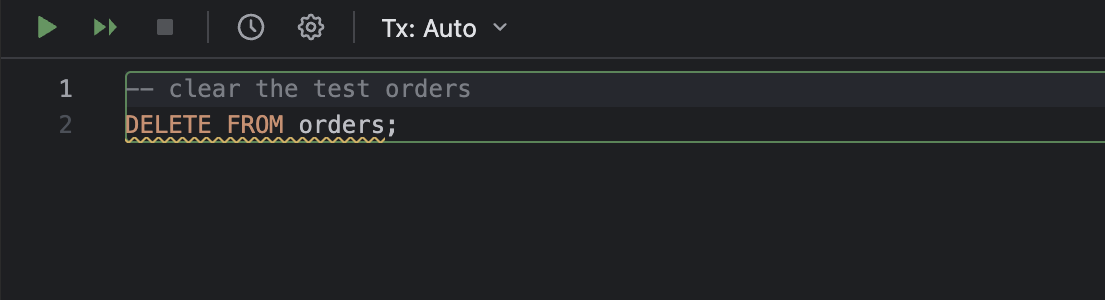
The whole statement is marked, comment excluded.
Turn inspections off with tablecloth.inspections.enabled.
Format SQL
⌘⌥L, or VS Code's own Format Document. The style follows IntelliJ's defaults: one clause per line, AND/OR indented under their clause, lists that pass 100 columns wrap aligned under the first item, subqueries as indented blocks, aligned column names in CREATE TABLE, and type names keep the case you wrote them in.